Visiting Carthage means learning to connect remains rather than searching for an intact ancient city. The landscape, preserved spaces and heritage interpretation provide several starting points. To make the visit meaningful, choose a connecting theme and understand what each stop actually allows you to observe. A photograph of the baths cannot replace that reading, but it can inspire the wish to begin.
The UNESCO dossier for Carthage places its Phoenician foundation in the ninth century BCE and describes its Punic and Roman history. That reference point does not interpret every visible feature. This guide offers cultural preparation: choosing questions, organising a suitable pace and confirming visiting arrangements, without advertising unverified opening hours, prices or access. The purpose is to make the experience clearer, not to prescribe a universal itinerary for every traveller.
Understand why Carthage cannot be read in one glance
An archaeological visit distinguishes the documented site, visible ensembles and the present-day city around them. What you see from one viewpoint is not a complete view of every period. Establish where you are within the visit and which subject the stop addresses before expecting each feature to explain the whole history of the place.
This method avoids a common disappointment: assuming that every remain will immediately tell the entire story of Carthage. One space may matter to a question about movement, another to an architectural reading or a research problem. Ask why the programme connects them. Meaning comes from these relationships, not only from the size of preserved features. A modest detail explained precisely may create a more lasting understanding than an impressive outline photographed without context. Different stops can contribute different kinds of knowledge without needing to compete for the most dramatic image.
Prepare a few reference points rather than a complete chronology
Distinguishing Punic and Roman phases gives an initial framework. It does not allow you to date a stone or building independently. Record unfamiliar terms in your sources and ask how they relate to the spaces visited. Preparation helps you follow an explanation on site; it should not require anticipating every answer before you arrive.
Separate the history of a place from the history of its study too. Excavation, restoration and heritage presentation belong to different times from ancient construction. Recognising that distinction helps you read plans and representations. In a notebook, you can use three headings: period discussed, feature observed and question to investigate. You do not need a complete narrative before departure. A few reliable reference points are more useful than spectacular anecdotes that are difficult to find again afterwards or impossible to connect with the particular features in front of you.
Byrsa: look for an overview
Byrsa Hill appears among the heritage components described by Tunisia's National Heritage Institute. If it is included in your programme, ask what observation from that sector helps explain and which parts are accessible when you visit. A familiar name does not guarantee an identical route to one described in an older guide.
Prepare a question about relationships: how is the sector situated in relation to the programme's other places? What do available plans show? Which explanations distinguish preserved features from reconstructions? An overview still needs these details. Avoid treating a panorama as evidence of an entire urban system. A viewpoint can organise curiosity, but conclusions should remain connected to the information actually presented. Asking what the view can and cannot establish is a useful way to begin an archaeological visit without expecting it to supply every answer immediately.
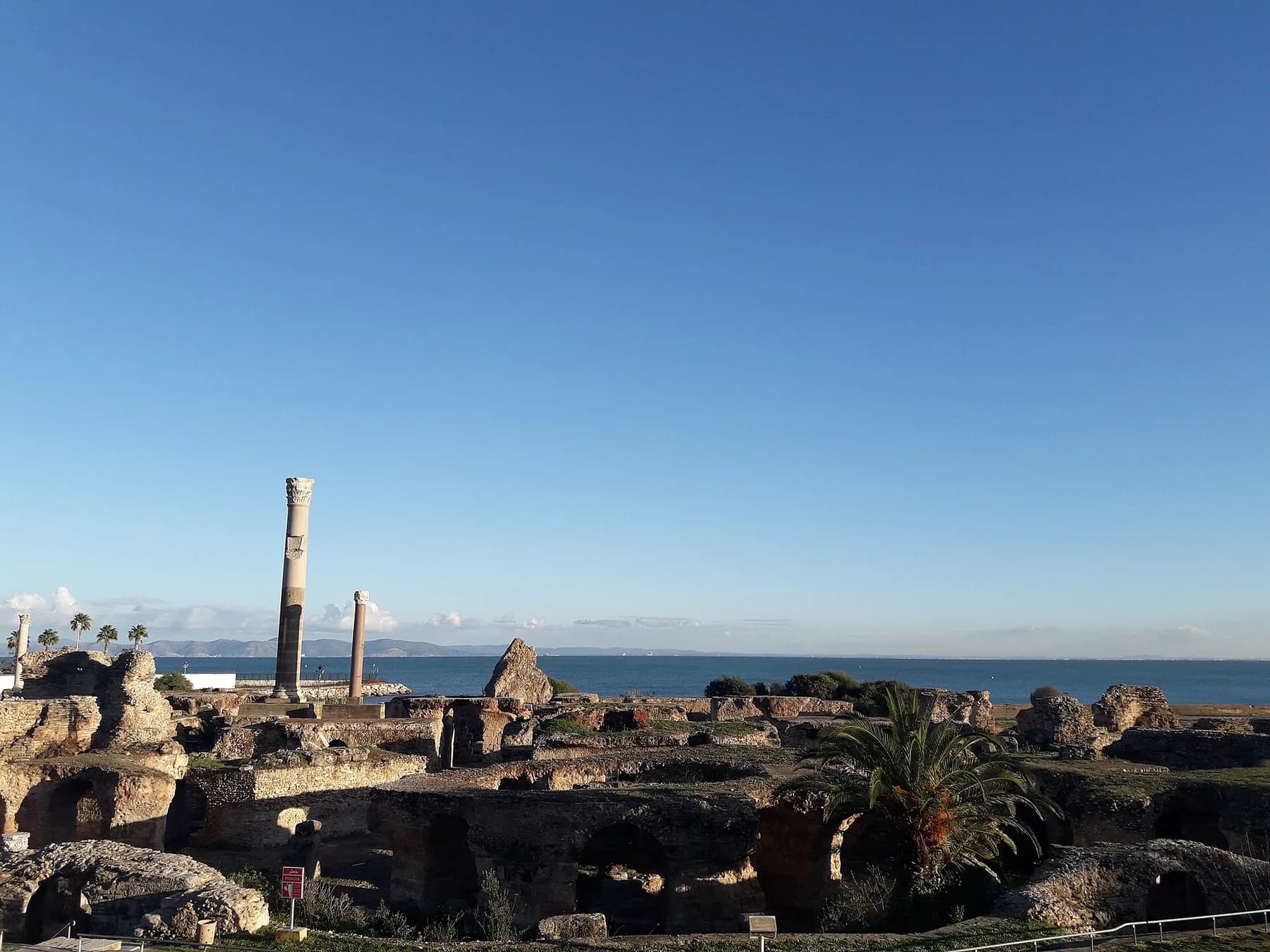
The Baths of Antoninus: read architecture before collecting images
The Baths of Antoninus are presented in the Institute's heritage documentation for Carthage. Begin with volumes, passages and relationships between visible parts. Ask what can be identified, what is missing and what visitor materials attempt to reconstruct. The stop then becomes an architectural reading rather than a search for the best-known photograph.
A building with missing elements is also understood through its absences. Listen to distinctions between remains, conservation interventions and reconstruction hypotheses. Visible details should not be placed independently into an imagined system without explanation. Choose a few questions about the organisation of spaces and return to them during the visit. This allows people unfamiliar with the vocabulary of baths to participate without feeling that interpretation is reserved for specialists. The aim is not to guess how everything worked, but to recognise the evidence and explanations that support the interpretation you are being offered.
The Punic ports: ask a question about exchange
The ports also feature in the Institute's heritage resources. A visit can support a theme about exchange and relationships with the coast, provided observable features and available explanations are clarified. Do not assume that present forms can be read without interpretation as a complete representation of every ancient phase or as a direct illustration of a story you already know.
Ask how knowledge is established: which sources are used, which plans help explain the stop and which questions remain open. Attention to reasoning makes the visit richer than an accumulation of stories about maritime power. It also connects the subject with other things you have seen during the programme. A cultural day becomes more coherent when a theme returns through several perspectives, without each stop being presented as a definitive conclusion. The question itself can guide what you notice and what you choose to investigate afterwards.
Decide what each stop contributes
A relevant route does not necessarily combine every heritage name into one day. It decides what each place contributes to a shared question. You might prioritise architecture, relationships between ensembles or the way archaeology presents knowledge to the public. These objectives call for different arrangements and different amounts of explanation at individual stops.
Ask which visits are priorities and which remain optional according to confirmed conditions. That hierarchy protects quality when the programme needs adjustment. The cultural tours offer a basis for discussing a group of visits, but the actual programme should clarify its content. A long list is not automatically more informative. Time spent understanding a relationship between two spaces may be more valuable than another stop made in a hurry. The route should leave room for questions instead of using every spare moment to increase the number of names on the itinerary.
Confirm practical information before departure
Opening arrangements, access, tickets and visible spaces can change. Confirm them with the responsible organisation or your organiser close to the visit. This guide does not offer reference figures that could be repeated as a promise. A cultural article should not hide uncertainty about practical information behind confident presentation or borrow a timetable from an older account without checking it.
Describe participants' needs as well. What walking pace suits the group? Which breaks are preferred? What guidance is proposed, and where does it begin? These matters belong in the programme. The map helps locate available content, but it does not by itself describe accessible routes or transfers that need arrangement. Preparing those details frees attention for observation and conversation in the field. It also helps distinguish the experience you are agreeing from a general description of what somebody else once visited.
Photograph Carthage without losing context
An image isolates one angle and one moment. For a more useful record, note the specific place, the question addressed and information you wish to retrieve. Do not treat every photograph as a complete testimony to Carthage. Some show an architectural detail; others help situate a relationship with the landscape. Their captions should reflect what they actually establish.
Follow site instructions and respect conservation areas. Do not climb on remains to obtain a viewpoint or move objects. If people appear in your frame, consider their preference not to be photographed. You can communicate a visit's interest without pursuing a dramatic image at any cost. A precise caption and a well-formulated question often make a stronger souvenir than a composition obtained by ignoring the visit's boundaries. They also give you a way to return to the subject later without relying entirely on the image to reconstruct your understanding.
Add a museum or another visit through a clear connection
A collection can complement the reading of a site when provenance and context are explicit. Do not assume that an object exhibited nearby automatically comes from the sector you have just observed. Ask which collections are accessible and how they contribute to the day's subject rather than including them only to increase the programme's apparent scope.
A proposal should distinguish possible visits from confirmed access. If a space is unavailable, the programme can be adapted without advertising a fictional replacement experience. Meaning comes from the relationship between retained elements. Our article on preparing an archaeological visit develops this method. It helps compare the contributions of a plan, object and field explanation without confusing different kinds of heritage presentation. A clear relationship can make a smaller selection more informative than a day that moves through every available display without a connecting question.
Give heritage protection a place in the visit
According to UNESCO, the archaeological site of Carthage has been on the World Heritage List since 1979. That recognition encourages careful attention; it does not mean that every space is open for visits or that each building visible nearby has the same status. Local instructions remain the practical reference for your route and the areas you may enter.
Protection also concerns how you describe the place. Avoid turning a hypothesis into a fact or an image of restoration into evidence of an entirely preserved state. Respect for heritage is not only a behavioural instruction beside the remains. It includes attention to sources and language. A cultural account can be accessible while clearly identifying what is observed, explained or still debated. That precision gives readers a basis for continuing their own curiosity and reduces the chance of an attractive but unsupported interpretation being repeated as established knowledge.
Prepare a cultural journey request around Carthage
Explain the themes that attract you, the group's composition and your preferred pace. A project can prioritise an accessible introduction or a more detailed reading, depending on available guidance. For a university, association or organisation, describe the fieldwork objectives too so that the programme can be developed around a real question rather than a collection of famous locations.
You can contact Nomadstrek Journeys to discuss visits and arrangements requiring confirmation. Visiting Carthage does not require seeing everything or knowing everything. It requires connecting places through a theme, recognising the limits of observation and allowing time for interpretation. The visit becomes a beginning: a more precise way to look at Tunisian heritage and continue exploring it after the journey. A few carefully understood relationships can be a stronger foundation for that exploration than a long list of monuments whose meanings remain disconnected.